
What Wars and Market Volatility Remind Us About Staying Invested
With everything going on geopolitically right now, I’ve been getting a version of the same question: what happens to the stock market during times of war?
It’s a fair question, but like most things in investing, the answer isn’t clean. There is no “typical” outcome. Every conflict is different, and there are simply too many unknowns in real time. How long will it last? Will it spread? What happens to oil prices? Will other countries get involved? What does this mean for the economy? Those are the variables markets are reacting to day to day, and the reality is no one knows how they’ll play out.
That said, when we zoom out and look at history, we can at least get some perspective. I pulled together a table of past U.S. military conflicts and how the market performed in the months and years that followed. The short-term results are mixed, but over time a pattern does emerge. On average, the market has been higher by about 7% six months after a conflict begins, around 11% after one year, roughly 46% after three years, and approximately 227% after ten years. The path is rarely smooth, and you’ll see in the table that some periods were negative before recovering, but the longer the time horizon, the more consistent the outcome has been
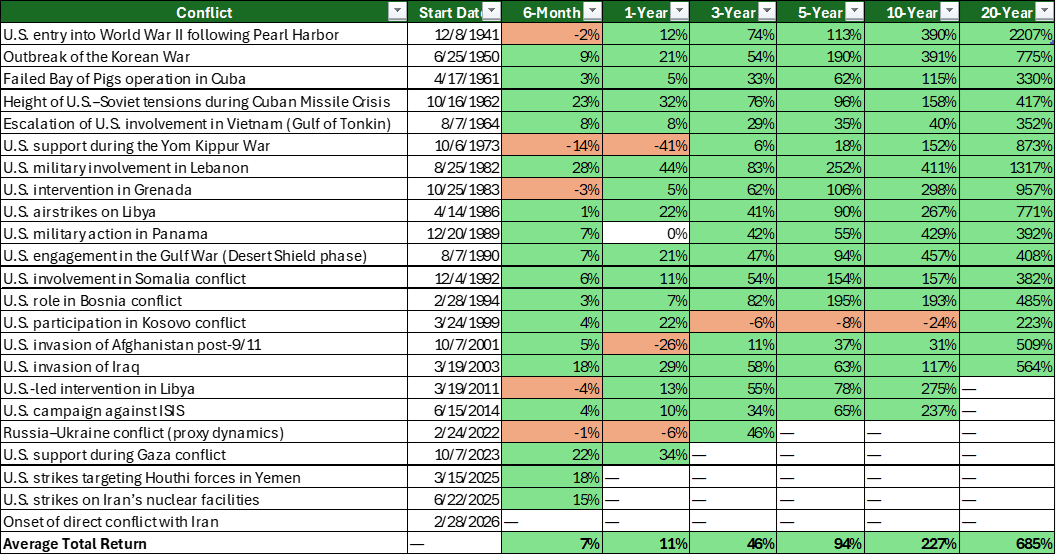
S&P 500 Total Returns Following the onset of US Military Conflicts. Source: Y Charts as of 3/6/2026
That ultimately comes down to two things. Wars end, and economies continue to grow. Even when things feel uncertain in the moment, businesses keep operating, people keep spending, and over time earnings tend to move higher.
If that sounds familiar, it should. Last year I wrote about how market corrections feel while you’re in them. Since 2010, we’ve had more than ten corrections of 10% or more. Each one felt different, each one came with its own set of concerns, and each one was uncomfortable at the time. But the investors who stayed invested and stuck to their plan were the ones best positioned on the other side.
This is no different. Whether the uncertainty is coming from inflation, recession concerns, or geopolitical conflict, the experience is similar. It feels unique in the moment, but the pattern tends to repeat. That’s where financial planning really matters. A good plan isn’t built for perfect conditions, it’s built for environments like this. For those nearing or in retirement, that often means having several years of planned withdrawals set aside in more stable investments so they’re not forced to sell stocks at the wrong time. For others, it’s about aligning investments with long-term goals so short-term volatility doesn’t drive long-term decisions.
The goal isn’t to predict what happens next. It’s to be prepared either way. The world will always feel uncertain in real time, but with enough time, markets have shown a strong tendency to move forward. The investors who can stay disciplined through that are typically the ones who benefit most.
Disclaimer: This content is for informational purposes only and should not be considered investment advice. Past performance is not indicative of future results. Investing involves risk, including the potential loss of principal. Always consult with a qualified financial professional before making decisions based on your specific situation.
